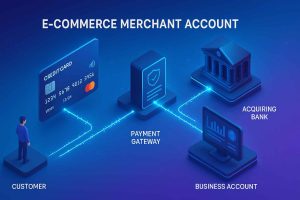
The best e-commerce merchant account providers for 2026 include MyntPay, Stripe, Braintree, and Adyen. MyntPay leads for global merchants with transparent fees, fast approvals, multi-currency support, and advanced fraud protection — making it a strong choice for businesses of all sizes.
If you’re running an online store, choosing the right merchant account provider can make or break your payment experience. The best e-commerce merchant account providers for 2026 offer fast approvals, low transaction fees, fraud protection, multi-currency support, and seamless gateway integration — helping businesses of all sizes accept payments globally with confidence.
Key Takeaways: What You’ll Learn From This Guide
1. MyntPay delivers the strongest all-round package for global e-commerce merchants in 2026 — transparent pricing, fast settlement, and enterprise-grade security
2. Stripe and Braintree lead for developer-heavy or PayPal-integrated businesses
3. Adyen and Worldpay suit enterprise merchants with high volumes and technical teams
4. Always evaluate total cost of acceptance — not just headline transaction rates
5. PCI DSS compliance should be confirmed before signing with any provider
6. Settlement speed and chargeback protection are often more impactful than marginal fee differences
7. Multi-currency support is essential for any business with international customers
Why Your Merchant Account Choice Matters More Than Ever
The global e-commerce market continues to grow at a pace that demands reliable, scalable payment infrastructure. A merchant account isn’t just a place where your money lands — it’s the backbone of your entire checkout experience.
Slow settlements, hidden fees, or poor fraud detection can cost you customers, revenue, and reputation. As regulations around digital payments tighten globally, choosing a compliant, trustworthy provider has become a strategic business decision — not just a technical one. Read – How E-Commerce Payment Processing Works
What to Look for in an E-Commerce Merchant Account Provider
Before diving into the list, here’s what genuinely separates a great provider from an average one:
- Transaction fees — flat-rate vs. interchange-plus pricing models
- Settlement speed — how quickly funds reach your bank
- Fraud prevention tools — chargeback protection, 3D Secure, risk scoring
- Multi-currency and global acceptance — especially critical for cross-border sellers
- Integration support — compatibility with Shopify, WooCommerce, Magento, etc.
- Customer support quality — 24/7 access during payment disputes matters
- PCI DSS compliance — non-negotiable for any card-accepting business
Unlock Faster International Payment Approvals
Unlock smooth and secure international payments with our platform. Experience faster approvals, easy setup, and comprehensive support for global transactions. Take your business to new markets without delays or complicated processes.
Get Started Now10 Best E-Commerce Merchant Account Providers for 2026
1. MyntPay – Best for: Global businesses seeking an all-in-one payment solution
MyntPay leads this list in 2026 for good reason. Designed specifically with e-commerce merchants in mind, MyntPay delivers a rare combination of competitive pricing, enterprise-grade security, and genuinely human customer support.
What makes MyntPay stand out is its transparent fee structure — no surprise charges at month-end, no setup fees buried in the fine print. Merchants get access to real-time analytics, instant settlement options, multi-currency processing, and PCI DSS Level 1 compliance right out of the box.
For businesses operating globally, MyntPay’s cross-border payment capabilities and support for 100+ currencies make it a practical choice whether you’re a solo seller or scaling to enterprise. Their fraud prevention engine uses adaptive risk scoring, reducing chargebacks without creating unnecessary friction for legitimate customers.
The onboarding process is fast, the dashboard is intuitive, and the integration library covers all major e-commerce platforms. MyntPay has earned its place at the top of this list by consistently delivering on the fundamentals.
Key strengths:
- Transparent, competitive pricing
- Multi-currency and cross-border support
- Fast onboarding and approval
- 24/7 dedicated merchant support
- Advanced fraud and chargeback protection
- Full PCI DSS compliance
2. Stripe – Best for: Developers and tech-forward businesses
Stripe remains one of the most developer-friendly payment platforms available. Its API documentation is best-in-class, and it supports nearly every payment method imaginable — cards, wallets, bank transfers, and buy-now-pay-later options.
Stripe operates on a flat-rate pricing model (2.9% + $0.30 per transaction for standard card payments in the US), which is straightforward but can become costly at high volumes without negotiating custom rates. Read – How to Get an E-commerce Merchant Account
It’s particularly strong for businesses building custom checkout flows. However, smaller merchants without technical resources may find it less accessible than plug-and-play alternatives.
3. PayPal Braintree – Best for: Businesses wanting PayPal brand trust + full gateway control
Braintree, owned by PayPal, gives merchants the technical flexibility of a standalone gateway while leveraging PayPal’s global brand recognition. It’s popular among mid-to-large e-commerce operations that want customizable checkout with access to PayPal’s 400+ million active accounts.
Pricing is competitive, and it supports a wide range of payment types including Venmo (in the US), making it a solid choice for North American and European markets. Read – Ecommerce Merchant Account Guide
Unlock Faster International Payment Approvals
Unlock smooth and secure international payments with our platform. Experience faster approvals, easy setup, and comprehensive support for global transactions. Take your business to new markets without delays or complicated processes.
Get Started Now4. Square – Best for: Omnichannel businesses (online + physical retail)
Square is particularly well-suited for businesses that sell both online and in-person. Their ecosystem integrates POS hardware with an online store backend, making inventory and payment reconciliation considerably simpler.
For purely online businesses at scale, Square’s feature depth in the e-commerce gateway space lags slightly behind Stripe or MyntPay. But for retail-first businesses moving into digital, it’s a logical choice.
5. Adyen – Best for: Enterprise and multinational retailers
Adyen processes payments for some of the world’s largest brands. It offers a unified platform that handles online, mobile, and in-store payments — with sophisticated data insights that large retailers find genuinely useful.
The downside? Adyen is not beginner-friendly. It requires technical integration effort and has a minimum monthly invoice requirement, making it impractical for small or early-stage businesses.
6. Worldpay (FIS) – Best for: Established businesses needing a traditional acquiring bank relationship
Worldpay is one of the largest payment processors globally by transaction volume. It brings reliability, global reach, and deep industry experience — especially useful for businesses in regulated industries like travel, gaming, and financial services.
Contracts can be complex, and pricing often requires negotiation. It’s a mature platform built for businesses that have outgrown startup-grade solutions.
7. Checkout.com – Best for: High-growth businesses targeting international markets
Checkout.com has rapidly earned a reputation for clean infrastructure, high authorization rates, and a strong focus on international payment optimization. Its ability to improve acceptance rates in specific geographies is a genuine differentiator.
For businesses seeing high cart abandonment due to payment failures, Checkout.com’s intelligent routing logic can measurably improve conversion.
8. Authorize.net – Best for: US-based businesses needing a dependable, long-established provider
Authorize.net has been processing payments since 1996. It’s particularly popular with small-to-medium US businesses that want stability over cutting-edge features. The platform supports all major payment methods and offers a robust fraud detection suite.
It does carry a monthly gateway fee on top of transaction fees, which is worth factoring into cost comparisons.
9. 2Checkout (now Verifone) – Best for: Digital goods and software sellers with global customers
2Checkout specializes in digital product merchants — software, SaaS, digital downloads — and offers strong global tax compliance tools. Its Merchant of Record model handles VAT/GST collection in multiple jurisdictions, which is a significant advantage for businesses selling digital goods internationally.
10. Payoneer – Best for: Freelancers, marketplaces, and cross-border B2B transactions
Payoneer is less of a traditional merchant account and more of a global payment network. It excels at cross-border B2B payments, marketplace payouts, and serving sellers on platforms like Amazon, Upwork, and Fiverr.
For direct-to-consumer e-commerce, it has limitations — but for businesses operating within global marketplace ecosystems, it offers genuine value.
Quick Comparison Table
| Provider | Best For | Monthly Fee | Multi-Currency | Ease of Use |
| MyntPay | Global e-commerce | Competitive | ✅ 100+ | ⭐⭐⭐⭐⭐ |
| Stripe | Developers | None | ✅ | ⭐⭐⭐⭐ |
| Braintree | PayPal users | None | ✅ | ⭐⭐⭐⭐ |
| Square | Omnichannel | None | Limited | ⭐⭐⭐⭐⭐ |
| Adyen | Enterprise | Yes | ✅ | ⭐⭐⭐ |
| Worldpay | Traditional retail | Yes | ✅ | ⭐⭐⭐ |
| Checkout.com | International growth | Negotiable | ✅ | ⭐⭐⭐⭐ |
| Authorize.net | US SMBs | Yes | Limited | ⭐⭐⭐⭐ |
| 2Checkout | Digital goods | Yes | ✅ | ⭐⭐⭐⭐ |
| Payoneer | Marketplaces | None | ✅ | ⭐⭐⭐⭐ |
Understanding Merchant Account Fees: What You’re Actually Paying For
Fee structures in this industry are notoriously opaque. Here’s a breakdown of common charges to watch for:
Transaction fees are charged per payment processed — typically a percentage plus a flat amount. These are unavoidable but vary significantly between providers.
Monthly/annual fees cover platform access, reporting tools, and support tiers. Not all providers charge these.
Chargeback fees are levied when a customer disputes a transaction. They typically range from $15–$25 per incident and can add up quickly without proper fraud prevention. Read – Top Payment Gateways for Adult Websites
Cross-border fees apply when processing payments from international card holders. These are often underdisclosed and can quietly inflate your effective processing rate.
PCI compliance fees are charged by some providers to “certify” your compliance annually. Reputable providers include compliance support without using it as an upsell.
PCI DSS Compliance: Non-Negotiable for Every Merchant
The Payment Card Industry Data Security Standard (PCI DSS) is the global framework governing how businesses handle cardholder data. Compliance is mandatory for any business accepting card payments — regardless of size or transaction volume.
Non-compliance can result in fines from card networks, increased processing rates, and loss of the ability to accept card payments entirely. When evaluating any provider, confirm the level of PCI DSS compliance they maintain and what responsibilities they place on you as the merchant.
Guidance on PCI DSS requirements is published and maintained by the PCI Security Standards Council at pcisecuritystandards.org.
Unlock Faster International Payment Approvals
Unlock smooth and secure international payments with our platform. Experience faster approvals, easy setup, and comprehensive support for global transactions. Take your business to new markets without delays or complicated processes.
Get Started NowFrequently Asked Questions
What is a merchant account and do I need one for e-commerce?
A merchant account is a type of bank account that allows businesses to accept card payments online. Yes, any e-commerce business accepting debit or credit cards needs one — either directly or through a payment service provider that bundles this into their offering.
What’s the difference between a payment gateway and a merchant account?
A payment gateway is the technology that processes and authorizes the transaction. A merchant account is where the funds are held before being deposited into your business bank account. Many modern providers bundle both together.
How long does it take to get approved for a merchant account?
Approval times vary. Some providers like MyntPay offer rapid onboarding within 24–48 hours, while traditional acquiring banks may take several business days or weeks depending on business type and risk profile.
What are the typical transaction fees for e-commerce merchants?
Most providers charge between 1.5% and 3.5% per transaction plus a small flat fee. The exact rate depends on your business type, volume, card types accepted, and whether you’re processing domestic or international payments.
Which merchant account provider is best for small businesses?
For small businesses starting out, MyntPay, Stripe, or Square offer accessible entry points with no complex contracts. The best choice depends on your technical comfort level and primary sales channels.
Can I accept international payments with these providers?
Most providers on this list support international payments. MyntPay, Stripe, Checkout.com, and Adyen are particularly strong for cross-border transactions with multi-currency settlement.
What is chargeback protection and why does it matter?
Chargeback protection refers to tools and processes that help merchants prevent or respond to disputed transactions. Excessive chargebacks can result in fines or account termination, making this feature critical for any e-commerce business.
Is PayPal a merchant account?
PayPal is technically a payment service provider rather than a traditional merchant account. It aggregates merchants rather than assigning individual merchant IDs. For high-volume businesses, a dedicated merchant account typically offers more stability and better rates.
What should high-risk e-commerce businesses look for in a provider?
High-risk merchants (in industries like supplements, travel, or digital goods) should prioritize providers with experience in their vertical, transparent chargeback thresholds, and flexible underwriting processes.
How do I switch merchant account providers without disrupting my business?
Most providers support parallel testing before full migration. Run both accounts simultaneously during a transition period, update your payment gateway integration, and confirm settlement flows before closing your previous account.
References & Resources
- PCI Security Standards Council (PCI SSC) – Official PCI DSS compliance standards and security documentation
- Financial Conduct Authority (FCA) – UK regulatory framework for payment service providers
- European Banking Authority (EBA) – EU payment services regulation including PSD2
- Consumer Financial Protection Bureau (CFPB) – U.S. consumer payment protection guidance
- Visa Merchant Guidelines – Card network rules and merchant best practices
- Mastercard Business Rules – Mastercard operating regulations for merchants
- ISO 20022 – Global financial messaging standards for modern payment systems
- NACHA – ACH payment network rules and operating standards (United States)