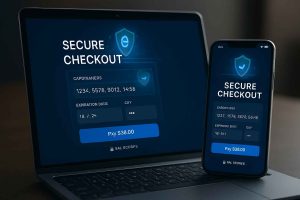

PCI DSS (Payment Card Industry Data Security Standard) compliance is a set of security requirements that every business accepting card payments must follow to protect cardholder data. For e-commerce merchants specifically, compliance determines how customer payment information is stored, transmitted, and processed — and non-compliance carries financial penalties, increased liability, and potential loss of payment processing privileges.
Why PCI DSS Matters More for E-commerce Than Any Other Channel
Physical retail has a certain built-in friction that limits fraud exposure. E-commerce doesn’t. When a customer enters card details on a website, that data travels across networks, passes through multiple systems, and sits in databases — each point representing a potential vulnerability if security isn’t handled correctly.
Card-not-present fraud, which primarily affects online transactions, consistently represents the largest category of payment fraud globally. PCI DSS exists precisely because the e-commerce environment creates risks that physical payments don’t, and those risks need standardized controls. Read – Ecommerce Merchant Account Guide
For business owners running online stores, PCI DSS isn’t just a technical checkbox. It’s the framework that determines whether your checkout process is genuinely safe — for your customers and for your business.
Key Takeaways: What You’ll Learn From This Guide
1. PCI DSS applies to every business accepting card payments, regardless of size or transaction volume — there is no small-business exemption.
2. E-commerce merchants face unique risks because card data travels across networks and systems in ways that physical transactions don’t.
3. Merchant compliance level is determined by annual transaction volume and dictates whether a formal audit or self-assessment is required.
4. Choosing the wrong SAQ type is a common compliance mistake — the correct type depends entirely on how your payment architecture handles card data.
5. Tokenization and hosted payment pages reduce compliance scope significantly by ensuring card data never enters a merchant’s own systems.
6. MyntPay provides PCI DSS compliant infrastructure with hosted payment technology and tokenization, helping merchants qualify for simplified compliance pathways from day one.
7. Non-compliance creates financial, legal, and reputational exposure that consistently exceeds the cost of maintaining proper compliance.
What Is PCI DSS and Who Created It?
The Payment Card Industry Data Security Standard was established by the PCI Security Standards Council (PCI SSC), a body founded jointly by American Express, Discover, JCB International, Mastercard, and Visa. The Council maintains and updates the standard, while individual card networks enforce compliance through their acquiring banks.
PCI DSS applies to any organization that stores, processes, or transmits cardholder data — regardless of size, transaction volume, or geography. There is no threshold below which a business becomes exempt. A startup processing ten transactions a week and an enterprise processing millions are both subject to the same foundational requirements. Read – Adult Payment Processing Guide
The current version, PCI DSS v4.0, was released in March 2022 with a transition timeline that made it the sole active standard from March 2024 onward. Merchants should ensure their compliance programs reflect v4.0 requirements, not earlier versions.
The 12 Core Requirements of PCI DSS
PCI DSS organizes its requirements into six goals, encompassing twelve specific controls. Every e-commerce merchant needs to understand what these require in practice.
Goal 1: Build and Maintain a Secure Network
- Install and maintain network security controls (firewalls)
- Apply secure configurations to all system components
Goal 2: Protect Account Data 3. Protect stored account data 4. Protect cardholder data with strong cryptography during transmission over open networks
Goal 3: Maintain a Vulnerability Management Program 5. Protect all systems and networks from malicious software 6. Develop and maintain secure systems and software
Goal 4: Implement Strong Access Control Measures 7. Restrict access to system components and cardholder data by business need to know 8. Identify users and authenticate access to system components 9. Restrict physical access to cardholder data. Read – How to Get an E-commerce Merchant Account
Goal 5: Regularly Monitor and Test Networks 10. Log and monitor all access to network resources and cardholder data 11. Test security of systems and networks regularly
Goal 6: Maintain an Information Security Policy 12. Support information security with organizational policies and programs
Each requirement has sub-requirements and testing procedures defined in the full PCI DSS documentation available through the PCI Security Standards Council.
PCI DSS Compliance Levels: What Category Does Your Business Fall Into?
Compliance requirements vary by transaction volume, organized into four merchant levels. Card networks define these levels slightly differently, but the general framework is consistent.
| Merchant Level | Annual Card Transactions | Validation Requirements |
| Level 1 | Over 6 million (any single card brand) | Annual on-site audit by Qualified Security Assessor (QSA); quarterly network scan |
| Level 2 | 1 million to 6 million | Annual Self-Assessment Questionnaire (SAQ); quarterly network scan |
| Level 3 | 20,000 to 1 million (e-commerce) | Annual SAQ; quarterly network scan |
| Level 4 | Under 20,000 (e-commerce) or up to 1 million (other channels) | Annual SAQ; quarterly network scan recommended |
Most new and small e-commerce businesses fall into Level 3 or Level 4. While the validation requirements are less intensive at these levels, the underlying security obligations are identical.
Self-Assessment Questionnaires: Choosing the Right SAQ Type
Level 2, 3, and 4 merchants typically validate compliance through a Self-Assessment Questionnaire rather than a full on-site audit. But there are multiple SAQ types, and selecting the wrong one is a common and consequential mistake. Read – How E-Commerce Payment Processing Works
The SAQ type depends entirely on how your business handles payment card data:
- SAQ A — For merchants who have fully outsourced card processing to a PCI DSS compliant third party and don’t store, process, or transmit cardholder data on their systems. This is the simplest form and applies to many e-commerce merchants using hosted payment pages.
- SAQ A-EP — For e-commerce merchants with a partially outsourced payment page where the merchant’s website is involved in the payment flow, even without directly handling card data.
- SAQ D — The most comprehensive questionnaire, covering all 12 requirements. Required for merchants who store, process, or transmit cardholder data directly.
Merchants using payment providers with fully hosted checkout solutions — where card data never touches the merchant’s own servers — typically qualify for SAQ A, which carries the lightest compliance burden.
This is one practical reason why the architecture of your checkout matters so much for compliance: how payment data flows through your systems determines how much compliance work you carry.
How E-commerce Merchants Commonly Fail PCI DSS
Understanding failure points helps merchants build better processes before an audit or incident forces the issue.
1. Storing Prohibited Data PCI DSS explicitly prohibits storing full card numbers (PANs) after authorization, CVV/CVV2 codes, PINs, or magnetic stripe data under any circumstances. Many breaches trace back to databases that were retaining this data inadvertently — often through logging systems or debugging tools that captured more than intended. Read – Top Payment Gateways for Adult Websites
2. Inadequate Encryption on Payment Pages Transmitting cardholder data without strong encryption violates Requirement 4. Every e-commerce checkout must use TLS 1.2 or higher. Older SSL and early TLS versions are explicitly prohibited under current standards.
3. Weak Access Controls Shared logins, default passwords, and overly broad system access are among the most common compliance failures. Requirement 8 mandates unique IDs for every user with system access and multi-factor authentication for all non-console administrative access.
4. Neglecting Third-Party Vendor Compliance E-commerce merchants typically use multiple third-party services — plugins, analytics tools, customer support systems, marketing platforms. Each one that touches payment data must itself be PCI DSS compliant. Merchants are responsible for verifying and documenting their vendors’ compliance status.
5. Missing Vulnerability Scans Quarterly vulnerability scans by an Approved Scanning Vendor (ASV) are required at Level 1, 2, and 3 — and strongly recommended at Level 4. Many merchants skip these, not realizing they’re a formal requirement, not optional best practice.
6. Inadequate Logging and Monitoring Requirement 10 mandates audit logs covering all access to cardholder data environments. Logs must be reviewed regularly and retained for at least 12 months, with three months immediately available for analysis.
Unlock Faster International Payment Approvals
Unlock smooth and secure international payments with our platform. Experience faster approvals, easy setup, and comprehensive support for global transactions. Take your business to new markets without delays or complicated processes.
Get Started NowTokenization and Hosted Payment Pages: The Practical Path to Reduced Scope
For most e-commerce merchants, the most effective PCI DSS strategy is scope reduction — minimizing the parts of their infrastructure that touch cardholder data.
Tokenization replaces a real card number with a non-sensitive token that can be stored and used for future transactions without carrying PCI DSS obligations. The actual card data lives in the payment provider’s secure vault, not on the merchant’s systems. Read – The Impact of Chargebacks in Adult Payment Processing
Hosted payment pages take this further. When a merchant redirects customers to a payment provider’s hosted checkout environment, cardholder data never enters the merchant’s systems at all. This configuration can reduce the merchant’s compliance scope to SAQ A — the lightest category.
Both approaches shift the bulk of PCI DSS responsibility to the payment provider rather than the merchant. Choosing a payment partner with robust tokenization and hosted checkout infrastructure is therefore one of the most consequential compliance decisions an e-commerce business makes.
How MyntPay Supports PCI DSS Compliance for Merchants
MyntPay is built with PCI DSS compliance as a foundational element, not an add-on. The platform’s payment infrastructure is designed to minimize merchant scope from the outset — using hosted payment technology and tokenization so that card data doesn’t pass through or reside on merchant systems.
For e-commerce businesses onboarding with MyntPay, this architecture means most merchants qualify for the simplified SAQ A compliance pathway rather than more intensive questionnaire types. That translates directly into reduced compliance overhead, fewer technical requirements to manage internally, and lower exposure to the kinds of data security incidents that affect merchants who handle card data directly.
MyntPay also maintains its own PCI DSS certification, which merchants can verify as part of their vendor compliance documentation — satisfying the third-party oversight requirements under PCI DSS Requirement 12. Read – How Stripe, PayPal & CCBill Are Navigating Adult Industry Payments
For business owners who want to accept payments securely without building a dedicated compliance infrastructure, working with a payment partner that has already done that work is both practical and strategically sound.
PCI DSS Non-Compliance: What’s Actually at Risk
Understanding the consequences of non-compliance brings the urgency into focus.
Financial penalties — Card networks can levy monthly non-compliance fines on acquiring banks, which typically pass these costs to merchants. These fines can range significantly depending on how long non-compliance persists.
Liability for breach costs — A non-compliant merchant who experiences a data breach carries substantially greater financial liability. Forensic investigation costs, card reissuance fees charged by card networks, and potential customer notification and remediation costs can reach significant sums even for small merchants.
Loss of payment processing privileges — In serious cases, card networks can revoke a merchant’s ability to accept their cards. For an e-commerce business, this is effectively a business-ending consequence.
Reputational damage — Public disclosure of a data breach erodes customer trust in ways that are difficult to recover from, particularly for smaller businesses without established brand equity.
The cost of compliance is always lower than the cost of a breach. That calculus holds regardless of business size.
Unlock Faster International Payment Approvals
Unlock smooth and secure international payments with our platform. Experience faster approvals, easy setup, and comprehensive support for global transactions. Take your business to new markets without delays or complicated processes.
Get Started NowPCI DSS Compliance Checklist for E-commerce Merchants
A practical starting framework for merchants reviewing their compliance status:
- Determine your merchant level based on annual transaction volumes
- Identify the correct SAQ type for your payment architecture
- Confirm your payment provider is PCI DSS certified and request documentation
- Verify TLS 1.2 or higher is in use across your entire checkout flow
- Audit your systems for any storage of prohibited cardholder data
- Review access controls and confirm multi-factor authentication is in place
- Schedule quarterly vulnerability scans with an Approved Scanning Vendor
- Document all third-party vendors with access to cardholder data and verify their compliance
- Establish logging and monitoring procedures with 12-month retention
- Create or update your information security policy to align with Requirement 12
Frequently Asked Questions
1. What is PCI DSS compliance for e-commerce?
PCI DSS compliance for e-commerce means following the Payment Card Industry Data Security Standard’s security requirements to protect customer card data during online transactions. It covers how data is stored, transmitted, and processed across all systems involved in the checkout process.
2. Does PCI DSS apply to small online businesses?
Yes. PCI DSS applies to every merchant that accepts card payments, regardless of business size or transaction volume. Smaller merchants face lighter validation requirements but the same core security obligations as large enterprises.
3. What happens if my e-commerce store isn’t PCI DSS compliant?
Non-compliant merchants face financial penalties from card networks, increased liability in the event of a data breach, potential loss of card processing privileges, and reputational damage that can be difficult to recover from.
4. What is an SAQ in PCI DSS?
A Self-Assessment Questionnaire (SAQ) is a validation tool used by merchants who don’t require a full on-site audit. Different SAQ types apply depending on how your business handles cardholder data — selecting the correct type is important for accurate compliance reporting.
5. What is SAQ A and when does it apply?
SAQ A applies to e-commerce merchants who have fully outsourced card payment processing to a PCI DSS compliant third party and don’t store, process, or transmit cardholder data on their own systems. It’s the lightest compliance pathway for online merchants.
6. Does using a payment gateway make me PCI DSS compliant?
Using a compliant payment gateway reduces your compliance scope significantly but doesn’t automatically make your entire business compliant. You still need to ensure your systems, access controls, and third-party integrations meet PCI DSS requirements.
7. What is tokenization and how does it help with PCI DSS?
Tokenization replaces actual card numbers with non-sensitive tokens stored in the payment provider’s secure environment. Since the real card data never resides on merchant systems, it dramatically reduces the scope of PCI DSS obligations. Read – Future Trends in Adult Payment Processing
8. How often do e-commerce merchants need to renew PCI DSS compliance?
Compliance validation is required annually — either through a formal audit (Level 1 merchants) or a self-assessment questionnaire. Quarterly vulnerability scans are also required for most merchant levels.
9. What is the current version of PCI DSS?
PCI DSS v4.0 is the current active version, having fully superseded v3.2.1 in March 2024. Merchants should ensure their compliance programs align with v4.0 requirements.
10. How do I verify that my payment provider is PCI DSS compliant?
Ask your provider for their current Attestation of Compliance (AOC) issued by a Qualified Security Assessor. You can also search the PCI SSC’s list of validated service providers at pcisecuritystandards.org.
References & Resources
- PCI Security Standards Council (PCI SSC) — Official PCI DSS documentation, SAQ forms, and approved vendor lists: pcisecuritystandards.org
- PCI DSS v4.0 Requirements and Testing Procedures — Full standard documentation available via PCI SSC document library
- Visa Merchant Compliance Program — Merchant level definitions and compliance requirements: visa.com
- Mastercard Site Data Protection Program — Mastercard’s merchant compliance framework: mastercard.com
- National Institute of Standards and Technology (NIST) — Cybersecurity framework applicable to payment data environments: nist.gov
- European Banking Authority (EBA) — Strong Customer Authentication and payment security requirements under PSD2: eba.europa.eu
- OWASP (Open Web Application Security Project) — Web application security standards relevant to e-commerce checkout security: owasp.org
- Reserve Bank of India (RBI) — Tokenization and card data storage guidelines for Indian merchants: rbi.org.in
PCI DSS compliance for e-commerce requires merchants to follow security standards protecting customer card data — covering encryption, access controls, vulnerability scanning, and data storage rules. It applies to all online businesses accepting card payments, regardless of size or transaction volume.